

Business Operation · 2025
In this section23 topics
- Corporate Information4 items
- Dividend Policy2 items
- Major Shareholders1 item
- Business Strategies Overview5 items
- Material Changes & Developments1 item
- Use of Proceeds from Securities Offerings1 item
- Commitments Made in the Registration Statement1 item
- Group Operating-Structure Policy1 item
- Companies Where the Company Holds ≥10%1 item
- Shareholders with Potential Conflict of Interest1 item
- Relationships Among Major Shareholders1 item
- Shareholders' Agreement1 item
- Shareholding Diagram (Group Structure)2 items
- Income Structure3 items
- Product / Service Characteristics2 items
- Research & Development6 items
- Assets Used in the Business4 items
- Marketing Policy & Competition4 items
- Procurement of Products & Services8 items
- Nature of Business — Overview1 item
- Projects Under Construction1 item
- Debentures & Bills of Exchange1 item
- Convertible Securities1 item
Corporate Information
Company Name
LAM SOON (THAILAND) PUBLIC COMPANY LIMITED
Telephone
0-2361-8959-70
Website
www.lamsoon.co.th
company.secretary@lamsoon.co.th
Dividend Policy
Dividend Policy
The Company’s policy is to pay dividends to shareholders of an amount not less than 40% of its net earnings after tax subject to the Company’s future investment and funding requirements. The Board of Directors passed a resolution to propose the payment of dividend for the operational period of 2025 at the rate of 0.22 Baht/share representing 54.49% of net profit after tax, compared with that of 2024 at 0.20 Baht/share representing 53.40% of net profit after tax.
Historical Dividend Payments
| This Year | Last Year | 2 Years Ago | 3 Years Ago | 4 Years Ago | Metric | Description |
|---|---|---|---|---|---|---|
| 0.4 | 0.37 | 0.43 | 0.32 | 0.44 | Net profit per share (Baht : Share) | Net profit per share (baht : share) |
| 0.22 | 0.2 | 0.25 | 0.19 | 0.25 | Dividend per share (Baht : Share) | Dividend per share (baht : share) |
| 0 | 0 | 0 | 0 | 0 | Dividend stock ratio (Number of original shares: dividend shares) | Ratio of stock dividend payment (existing share : stock dividend) |
| 0 | 0 | 0 | 0 | 0 | Dividend share value per share (Baht : Share) | Value of stock dividend per share (baht : share) |
| 0.22 | 0.2 | 0.25 | 0.19 | 0.25 | Total dividend payment value (Baht : Share) | Total dividend payment (baht : share) |
| 54.49 | 53.4 | 58.03 | 58.62 | 56.98 | Dividend payout ratio to net profit (%) | Dividend payout ratio compared to net profit (%) |
Business Strategies Overview
Chairman's Message
From August 2024 until February 2025, due to rainfall deficit, oil palm output had been continuously decreased. The critically low stock level in the Kingdom caused domestic CPO price to rise sharply to 50 Baht per Kg in early February. However, after the crop harvesting season began in March, CPO price began to drop sharply and recorded its lowest level in May 2025 at 31 Baht per Kg when Fresh Fruit Bunches (FFB) reached an unprecedented level of nearly 3 million MT. The high level persisted through the end of the year. As a result, total FFB output in 2025 reached more than 21 million MT., which was also a record high. Despite a high supply of FFB, the average price for the year stood at 6.66 Baht per Kg (2024: 6.20 Baht per Kg).
Nevertheless, the Government did not introduce any measurement to restore balance in palm oil market. During this period, the biodiesel blending ratio continued to be set at B5. Domestic crushing mills took advantage of high CPO price in global market to offload their stocks by exporting CPO as much as over 1.2 million MT. to India. This development effectively maintained the supply–demand balance in the absence of any government intervention.
The Company has always been sensitive to the potential changes in government policy and seasonal volatility of palm oil market, as these may adversely affect business operations. The Board of Directors has accordingly adopted conservative and prudent practices.
Our goal is to become a leading food and food-related Company with sustainable growth and development. Maintaining a balance between generating appropriate profits and building long-term sustainability remains central to your Company’s strategic direction.
To this end, various investment projects aligning with the established Vision have been initiated to actively integrating ESG pillars into regular business processes. They include sustainable FFB sourcing under RSPO standard, environmental management through effective wastewater treatment (Biogas Project and CDM) and greenhouse gas reduction (carbon footprint project and net zero carbon emission targeted in 2040), and energy saving project (solar rooftop), together with community engagement. In addition, your Company at all times upholds a strong commitment to respecting human rights and complying with applicable labour standards.
The Company also upholds the CG Code, particularly ensuring transparency, maintaining anti-corruption mechanisms and enforcing a Code of Business Conduct.
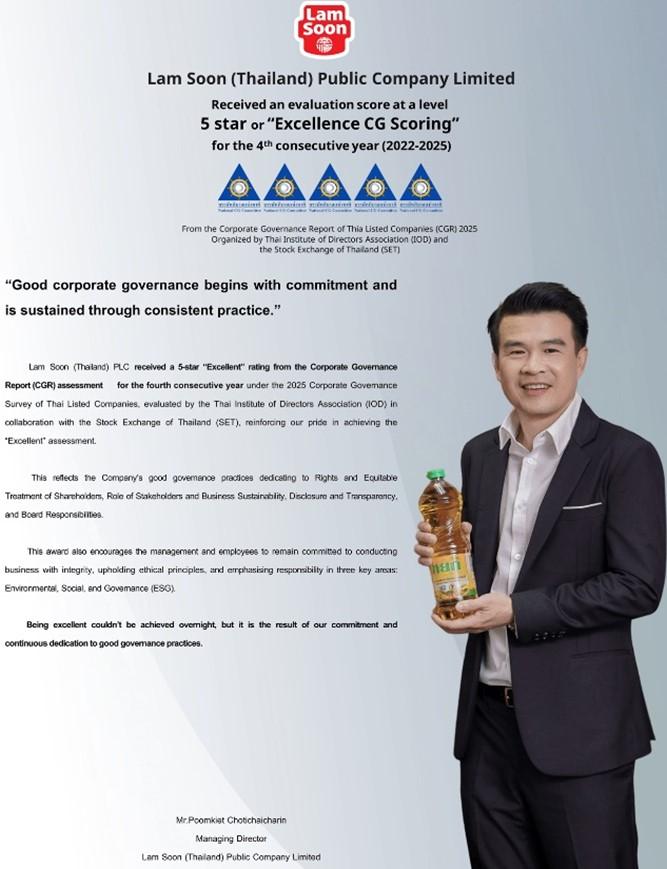
Last year marked the fourth consecutive years that the Company received an evaluation score at 5 stars or Excellent CG Scoring from the survey on Corporate Governance Report of Thai Listed Companies 2025 (CGR) of the Thai Institute of Directors (IOD).
This is the outcome of our business management continuously aligning with CG principles, with respect to 4 following dimensions:
rights of shareholders and equitable treatment of shareholders,
role of stakeholders and sustainable business development,
disclosure and transparency, and
responsibilities of the Board
In addition, to ensure that practices are conducted in accordance with your Company’s Code of Business Conduct framework, employees are informed of, and are required to confirm their compliances with, the Business Ethics on an annual basis.
I would like to thank the Board of Directors, the Management and all employees for their support and dedication in well performing their duties, enhancing the Company to continuously earn favorable operating results.
On behalf of the Board of Directors, I wish to express my sincere thanks and appreciation to shareholders, customers, business partners and alliances, and all stakeholders for rendering their full-fledged support to driving the Company’s business towards success and enabling it to maintain a strong and sustainable presence in Thailand’s palm oil industry for many years. We look forward to your continued support in the future.
Mr. Thira Wipuchanin
Chairman
Message from Managing Director
Company’s Performance
In 2025, despite various headwind factors including softening economy, political instability, ongoing geopolitical tensions, lower number of tourists, the Company successfully recorded sales revenue at 9.1 billion Baht, an increase of 1.1 billion Baht or 13.9% (2024 : 8.0 billion Baht); dividends received from two subsidiaries amounted to 137.6 million Baht, a decrease of 3.1 million Baht. The Company recorded profit for the year at 331.1 million Baht, an increase of 24.0 million Baht or 7.8% (2024 : 307.1 million Baht).
An increase in sales revenue was mainly due to:
a) The average selling price increased as a result of higher domestic raw material price compared to the previous year, particularly during the beginning of the year. This was driven by volatility in global supply and demand conditions for palm oil and palm kernel oil, which in turn caused fluctuations in domestic prices. In 2025, the difference between the highest and lowest average monthly prices of Crude Palm Oil, the Company’s key raw material was as high as 14 Baht per kilogram. In order to protect our profitability, we have offered our products to the customers at the right prices in accordance with an increase in the average cost in every product category, resulting in an increase in sales value compared to prior year, while maintaining the profitability.
b) A decrease in sales volume was negatively affected from weakening economy situation which made some food operators to close down, resulting in a negative volume demanding from food and restaurant businesses. However, volume for retail and industry customers still showed positive momentum despite challenges from the overall economic situation.
United Palm Oil Industry Public Company Limited (UPOIC), a 69.96% subsidiary of the Company, recorded sales revenues in 2025 of 1.9 billion Baht (2024 : 1.7 billion Baht) and a net profit of 218.9 million Baht (2024 : 162.8 million Baht).
Universal Food Public Company Limited (UFC), a 98.85% subsidiary of the Company, sales revenues in 2025 decreased by 3.3% to 2.5 billion Baht (2024: 2.6 billion Baht). Revenues decreased mainly due to export sales, resulting in net profit dropping by 23.2% to 183.0 million Baht (2024: 238.3 million Baht).
The overall consolidated group profit for the year increased from 568.7 million Baht in 2024 to 596.1 million Baht, or an increase of 4.8%.
Production and Investment
In 2025, the Company continually proceeded its investment projects, including the construction of an oil refinery plant to accommodate rising production volumes and the capacity expansion of margarine plant which are scheduled for completion in 2026.
In 2025, the Trang Crushing Mill completed the installation of an Electrostatic Precipitator (ESP) system for dust collection from the Boiler's chimney stack, as well as an online dust monitoring system (CEMS). Both systems were commissioned and began operation in November 2025 to mitigate pollution impacts on the surrounding community environment. Additionally, in May 2025, Trang Crushing Mill began construction on an expansion project for a 5,000 tons capacity crude palm oil storage tank, which was completed in December 2025. Concurrently, in August 2025, the company invested in replacement the Kernel pressing machine to improve production efficiency; this replacement is scheduled for completion in March 2026.
In the meantime, over the past year, UPOIC has invested in several key projects. One of the most significant initiatives was the installation of machinery to improve the Oil Extraction Rate (OER), which has now been completed. This investment has enhanced its production efficiency, reduced losses, and strengthened the company’s long-term competitiveness.
Likewise, Electrostatic Precipitator (ESP) system was installed at UPOIC to control air pollutant emissions, minimise environmental impacts, and elevate the sustainability standards of the production process.
In 2026, UPOIC is currently undertaking two new projects with strong potential to generate additional revenue and add value to by-products from the production process:
Empty Fruit Bunch (EFB) Boiler Project: to use waste to generate energy
Mixed Lagoon Digester (MLD) Project: to use decanter cake as feedstock to produce biogas
UFC remains committed to strengthening its position in consumer well-being products, with a clear focus on delivering high-quality food and beverages that support healthier lifestyles. The company prioritizes product quality, safety, and consistency, alongside thoughtful formulation and balanced nutrition, to meet the evolving needs of modern consumers.
UFC continues to invest in advanced production technology, rigorous food safety standards, and sustainable packaging to ensure reliable quality and environmental responsibility. Through responsible growth and operational excellence, UFC aims to create long-term value for consumers, society, and the business, while contributing positively to overall quality of life.
Marketing
The year 2025 presented not only opportunities, but also a series of challenges driven by shifts in political climate, administrative direction, global economic volatility, and the impact of natural disruptions affecting supply chains and consumer sentiment. These conditions have accelerated change across the industry, compelling all businesses to adapt decisively, refine strategies, and stay closely connected to the evolving needs of the people.
Against this backdrop of uncertainty, our marketing direction has been grounded in resilience and transformation. We expanded our product offering to support healthier and more informed consumption by introducing Naturel Extra Virgin Olive Oil and Naturel Light & Mild Olive Oil in new 1-litre in glass bottles, delivering premium quality with better value for households that consume olive oil regularly. We also launched Zest Cheese-Flavoured Margarine, a plant-based option created for cheese lovers seeking flavour and better nutrition without compromise.
In addition to strengthening retail performance, we continued building capabilities within the foodservice and industrial sectors, offering customised product solutions that cater to unique production and culinary requirements. Stability in this segment reinforces our long-term competitiveness.
Looking toward 2026, we are advancing into the next phase of capability expansion through investment in new processing technology and innovation-driven production. We believe that good food forms the foundation of better health for the nation, and therefore, we must continue improving, evolving, and innovating—despite all challenges.
Uncertainty has not weakened us, but it has sharpened our focus and propelled us forward. With continued resilience, collaboration, and innovation, we are determined to build brands that deliver value today while shaping a stronger future for Thai consumers.
Sustainability and Community
Lam Soon Group is committed to creating business growth alongside responsibility for the environment, social, and governance. In 2025, we implemented activities under "The NICE Way" project, which reflects our core values in creating shared value with all stakeholders.
NICE consists of 4 pillars:
N - eNsure efficient use of resources and energy throughout the value chain
I - Innovate innovation and development of nutritious products under international safety standards
C - Conduct business operations under good governance, transparency, and accountability
E - Educate providing knowledge and raising awareness about sustainable consumption in the society
Key activities that we implemented last year included:
NICE Knowledge encouraging employees to learn through online courses from the Stock Exchange of Thailand to build fundamental understanding of ESG and cultivate a sustainability DNA.
NICE Nourish in collaboration with Scholars of Sustenance Foundation (SOS), delivering surplus quality food to vulnerable communities and small schools through the Food Rescue Kitchen and Healthy Meals programs, to reduce food waste and strengthen food security.
NICE Suggestion providing opportunities for employees to propose sustainability ideas for development and implementation within the organisation.
NICE Everyday and NICE In Action promoting environmentally friendly behaviors such as waste separation and using personal water bottles instead of paper cups or plastic bottles.
These commitments reflect our vision of creating balance between business growth and environmental and social responsibility for long-term sustainability, with emphasis on collaboration with all sectors to drive sustainable growth moving forward.
Human Resources and Corporate Culture
Lam Soon Group values our employees as the organisation's most valuable asset. We are committed to developing and motivating our people to achieve their full potential, competencies, and sustained organisational commitment.
In 2025, we established a clear human resources strategy consisting of 4 pillars:
Enhance HR Capability to develop efficient and modern human resources management that meets business needs.
Foster Employee Engagement through creating a positive work environment that promotes happiness and quality of life at work.
Empower Employee Growth by focusing on continuous skill development, learning, and creating clear career advancement paths.
Strengthen Employer Brand to position the organisation as an employer of choice that attracts quality talent.
From this commitment, in 2025 all Lam Soon sites (Bang Na, Bangpoo, and Trang) received the Outstanding Establishment Award for Labour Relations and Labour Welfare at the national level from the Department of Labour Protection and Welfare, Ministry of Labour, demonstrating our consistent standard of fair employee welfare throughout the organisation.
With our human resources strategy that emphasizes people development alongside creating a positive work environment, we are confident in building a strong organisation that grows sustainably with all our employees.
Mr. Poomkiet Chotichaicharin
Managing Director
Vision
The leading food and food related company with sustainable growth and development.
Objectives
Mission
1. Manufacturing and distributing high quality and nutritious food product together with innovative production for novel food to fulfill customer requirements as well as providing the best services and building capacity which is able to be competitive in the future
2. Employing advanced technology with international management system as well as taking care of the environment, communities, and society
3. Building trust and confidence toward our customers, and allocate compensation or dividend to shareholders, and other stakeholders appropriately. Moreover, healthy, safety, and welfare of all employees are always taken into highly consideration
Goals
The topmost organisation targets include to add the Company’s values, the stakeholder benefits, and consistently contributing to shareholders’ wealth in the longer term.
Business Strategies
The Company commits to achieve business goals with transparent operations, ethical integrity, respecting human rights, sustaining well-being communities and the environment, and applying advanced technology to increase production efficiency and promote the community’s environmental friendliness. All of these visions vital in attaining the topmost organisation targets i.e. the Company’s values, the stakeholder benefits, and consistently contributing to shareholders’ wealth in longer term. The Company’s business strategies are categorised into the following dimensions.
Cost-Efficiency Management Strategy:bjective is to mitigate the impact of raw material price fluctuations.
1.1 Enhance production efficiency of both upstream and downstream operations
1.2 Invest in advanced and modern technologies to strengthen operational capabilities
1.3 Minimise losses throughout all stages of the production process
1.4 Promote utilising renewable energy sources
Value Creation and Revenue Diversification Strategy: Objective is to reduce dependence on revenue generated from products with highly volatile cost structures.
2.1 Transform palm oil into value–added products while improving features and benefits of palm olein from with new technology in production process
2.2 Focus on more premium market through health-focused products to align with consumers’ higher demand of more health-conscious products
2.3 Expand the business through collaboration with strategic alliances “bakery ingredient shop,” fostering strong
and sustainable growth within the food and bakery ingredients sectors
Marketing Strategy: Objective is to strengthen consumer recognition of the Company’s core brand.
3.1 Emphasise a diverse range of marketing activities, including the introduction and promotion of all product
categories, with a particular focus on new value-added products
3.2 Engage consumers with comprehensive communications across all channels
3.3 Modernise and enhance the image of the core brands to ensure effective and strengthen brand equity
Sustainability Strategy: Objective is to create long-term value for the Company through balanced and responsible business practices.
4.1 Operate the business in accordance with principles of Good Corporate Governance
4.2 Conduct the business prudently while maintaining an appropriate capital structure
4.3 Operate the business in compliance with the established sustainability standards
4.4 Protect the environment, support communities, and respect human rights
Material Changes & Developments
Material Changes & Developments
| Year | Description |
|---|---|
| 2,025 | 1. Sustainability Committee : The Sustainability Committee Meeting No.1/2025 on 10 December 2025 resolved to approve the appointment of Ms. Anjit Ply-ngam, Manager -- HR Center of Excellence, to be a member of SC, replacing Mrs. Jeeratchaya Siriwattamon (resigned), with effect from 10 December 2025. 2. Continuous Investments
|
Use of Proceeds from Securities Offerings
Is There Money Raised from a Securities Offering Still to Report On?
No
Commitments Made in the Registration Statement
Are There Commitments or Conditions from an Offering or Listing?
No
Group Operating-Structure Policy
Description
The Company and its subsidiaries have a policy of managing the business by hiring professionals and being independent of each other. In addition, the Company has appointed individuals to be directors in both subsidiaries. The objective is to implement policies and manage the businesses in various aspects of the Group in order to maximise the efficiency.
In 2025 the Company’s purchases of CPO, CPKO, PKS and FFB from UPOIC accounted for 8.99% (2024 : 11.87%) of its total CPO, CPKO, PKS and FFB purchase. The buying was based on the ongoing market price as normal business transaction on an arm’s length basis. It was done without any commitment, but on the basis of the CPO purchase contract and in compliance with normal business practice in the palm oil industry. For UFC products, the Company will continue to act as distributor of UFC by buying the products from UFC at the selling price sold by the Company less a fixed margin which is determined on an arm’s length basis between the two companies’ respective management.
Companies Where the Company Holds ≥10%
Companies (≥10% Holding)
| Company Name | Address | Province | Zip Code | Telephone | Fax | Business Type | Security Type | Shares | Paid-up Shares |
|---|---|---|---|---|---|---|---|---|---|
| United Palm Oil Industry Public Company Limited | 64 Soi Bangna-Trad 25, Khwaeng Bangna Nuea, Khet Bangna | Bangkok | 10260 | 027441046 | 023618989 | A plantation company that produces crude palm oil (CPO) and crude palm kernel oil (CPKO) | Common shares | 226,715,110 | 324,050,000 |
| Universal Food Public Company Limited | 60 Soi Bangna-Trad 25, Khwaeng Bangna Nuea, Khet Bangna | Bangkok | 10260 | 023988555 | Fruit and vegetable processing; Manufacturer of beverages, sauces and seasonings, and household care products for sale in both the domestic and export markets | Common shares | 51,894,657 | 52,500,000 | |
| United Palm Oil Industry Public Company Limited | 64 Soi Bangna-Trad 25, Khwaeng Bangna Nuea, Khet Bangna | Bangkok | 10260 | 027441046 | 023618989 | A plantation company that produces crude palm oil (CPO) and crude palm kernel oil (CPKO) | Common shares | 226,715,110 | 324,050,000 |
| Universal Food Public Company Limited | 60 Soi Bangna-Trad 25, Khwaeng Bangna Nuea, Khet Bangna | Bangkok | 10260 | 023988555 | Fruit and vegetable processing; Manufacturer of beverages, sauces and seasonings, and household care products for sale in both the domestic and export markets | Common shares | 51,894,657 | 52,500,000 |
Income Structure
Product / Service Income
| Category | Description | This Year | This Year % | Last Year | Last Year % | 2 Years Ago | 2 Years Ago % |
|---|---|---|---|---|---|---|---|
| Total revenue from operations | Total revenue from operations | 12,818,401 | 100 | 11,590,087 | 100 | 10,769,055 | 100 |
| Crude Palm Oil and By-Products | 2,267,748 | 17.69 | 1,959,347 | 16.91 | 1,800,590 | 16.72 | |
| Refined and processed palm products | 5,687,039 | 44.37 | 5,031,080 | 43.41 | 4,928,539 | 45.77 | |
| Other Oil Products (Non-Palm) | 1,247,984 | 9.74 | 884,903 | 7.63 | 728,134 | 6.76 | |
| Margarine and Shortening group | 954,355 | 7.45 | 978,538 | 8.44 | 922,326 | 8.56 | |
| Canned fruits and vegetables group | 431,538 | 3.37 | 584,176 | 5.04 | 672,962 | 6.25 | |
| Beverage group | 1,992,429 | 15.54 | 1,929,361 | 16.65 | 1,498,394 | 13.91 | |
| Sauce & Seasoning group | 100,035 | 0.78 | 97,713 | 0.84 | 102,167 | 0.95 | |
| Selling Electricity power to PEA | 31,116 | 0.24 | 22,703 | 0.2 | 25,506 | 0.24 | |
| Other | Others | 106,157 | 0.83 | 102,266 | 0.88 | 90,437 | 0.84 |
Export Income
| Category | Description | This Year | This Year % | Last Year | Last Year % | 2 Years Ago | 2 Years Ago % |
|---|---|---|---|---|---|---|---|
| Total revenue | Total revenue | 12,818,401 | 100 | 11,590,087 | 100 | 10,769,055 | 100 |
| Domestic | Domestic | 10,465,011 | 81.64 | 9,227,363 | 79.61 | 8,700,956 | 80.8 |
| International | International | 2,353,390 | 18.36 | 2,362,724 | 20.39 | 2,068,099 | 19.2 |
Other Income
| Operating Other Income | Non-Operating Other Income | Share of Profit |
|---|---|---|
| 1710 · As of year: 139426.0 · Description: Total other income · As of yesteryear: 127296.0 · As of year before yesteryear: 125921.0 · 1711 · As of year: 0.0 · Description: Other income from operations · As of yesteryear: 0.0 · As of year before yesteryear: 0.0 | 1712 · As of year: 139426.0 · Description: Other income not from operations · As of yesteryear: 127296.0 · As of year before yesteryear: 125921.0 | 1713 · As of year: 15474.0 · Description: Share of profit · As of yesteryear: 9427.0 · As of year before yesteryear: 62547.0 |
Product / Service Characteristics
Business Type
3114
Business Groups
| Business Group | Description | |||||||||||||||||||||||||||||||||||||||||||||||||||||||||||||||||||||||||||||||||||||||||||||||||||||||||||||||||||||||||||||||||||||||||||||||||||||||||||||||||||||||||||||||||||||||||||||||||||||||||||||||||||||||||||||||||||||||||||||||||||||||||||||||
|---|---|---|---|---|---|---|---|---|---|---|---|---|---|---|---|---|---|---|---|---|---|---|---|---|---|---|---|---|---|---|---|---|---|---|---|---|---|---|---|---|---|---|---|---|---|---|---|---|---|---|---|---|---|---|---|---|---|---|---|---|---|---|---|---|---|---|---|---|---|---|---|---|---|---|---|---|---|---|---|---|---|---|---|---|---|---|---|---|---|---|---|---|---|---|---|---|---|---|---|---|---|---|---|---|---|---|---|---|---|---|---|---|---|---|---|---|---|---|---|---|---|---|---|---|---|---|---|---|---|---|---|---|---|---|---|---|---|---|---|---|---|---|---|---|---|---|---|---|---|---|---|---|---|---|---|---|---|---|---|---|---|---|---|---|---|---|---|---|---|---|---|---|---|---|---|---|---|---|---|---|---|---|---|---|---|---|---|---|---|---|---|---|---|---|---|---|---|---|---|---|---|---|---|---|---|---|---|---|---|---|---|---|---|---|---|---|---|---|---|---|---|---|---|---|---|---|---|---|---|---|---|---|---|---|---|---|---|---|---|---|---|---|---|---|---|---|---|---|---|---|---|---|---|---|---|---|
| 1. Crude Palm Oil and By-Products 2. Refined and processed palm products 3. Other Oil Products (Non Palm) 4. Margarine and Shortening group 5. Canned fruits and vegetables group 6. Beverage group 7. Sauce & Seasoning group 8. Flour and Bakery ingredients group 9. Spices and Herbs group, Sauces and condiments / Spices 10. Pasta group 11. MISC Food Items e.g. Organic Rice (Jasmine Brown Rice / Riceberry / RD 43 Rice) 12. Household care products |
|
Research & Development
Has R&D Policy (Y/N)
Yes
R&D Cost — Description
Beginning in 2024, the Company has formally separated and allocated dedicated budgets and investments for research and development activities to strengthen product innovation capabilities and enhance operational efficiency. The allocated budget encompasses key R&D functions such as quality and nutritional analysis of new products, preparation of product samples and prototype packaging for customer presentations and conducting product application tests both internally and in collaboration with customers. It also includes evaluations of new packaging materials, market research to support new product development, and regulatory processes such as food product registration, halal certification, customs tariff interpretation for imported raw materials, and trademark registration for new Company products.
In addition, the Company places strong emphasis on capability development for R&D personnel through specialized training on food regulations, labeling requirements, and emerging trends and innovations within the food industry, ensuring that the organization remains competitive and aligned with market needs. The expansion of R&D staffing, particularly in packaging development, further enhances the Company’s ability to respond quickly and effectively to customer demands for new products and packaging solutions.
Overall, the Company maintains continuous research and development initiatives each year, covering product formulation, raw materials, packaging development, production processes, processing-related chemicals, and the acquisition of analytical equipment necessary for quality assessment. These efforts are supported by the ongoing monitoring and compliance with relevant food laws and regulatory requirements, reinforcing product quality and strengthening the Company’s long-term competitiveness.
R&D Cost — Label
Research and development (R&D) expenses over the past 3 years (Million Baht)
R&D Cost — This Year
137385146.06
R&D Cost — Last Year
95730077.75
R&D Cost — 2 Years Ago
485735113.15
Assets Used in the Business
Permanent Assets — Description
The Company and subsidiaries have the following fixed assets operated in the business:
- Oil palm plantations
- CPO and CPKO crushing mills
- Palm oil refinery
- Manufacturing plant for canned fruit, vegetable, and juice.
Intangible Assets — Description
The Company and subsidiaries have the software computer as intangible assets.
Has Subsidiaries Investment Policy (Y/N)
Yes
Subsidiaries Investment Policy — Description
In view of diversifying business risk, the Company has a policy to invest in subsidiaries or associated companies that support the Company's core business or food related business, which the Company sees as a way to create mutual benefits and increase channels for generating income, as well as the Company's profitability, under appropriate and manageable business risks. The Company will consider investment by evaluating the business value, considering the expected return on investment and financial status of the Company under an appropriate level of risk before making an investment decision.
Such investment decision must be approved by the Board of Directors' Meeting or the Shareholders' Meeting (as the case may be).
Marketing Policy & Competition
Reporting Mode
3117
Marketing Policy (Overall)
2025 presented not only opportunities, but also a series of challenges driven by shifts in political instability, administrative direction changes, global economic volatility, geopolitical tensions, and the impact of natural disruptions affecting supply chains and consumer sentiment. These conditions have accelerated changes across the industry, compelling all businesses to adapt decisively, refine strategies, and stay closely connected to the evolving needs of both customers and consumers.
Against this backdrop of uncertainty, our marketing directions have been grounded in resilience and transformation. We expanded our product offerings to support healthier and more informed consumption.
In addition to strengthening retail performance, we continued building capabilities within the food service and industrial sectors, offering customized product solutions that cater to unique production and culinary requirements. Stability in this segment reinforces our long-term competitiveness.
Looking toward 2026, we are advancing into the next phase of capability expansion through investment in new processing technology and innovation-driven production. We believe that good food forms the foundation of better health for the nation, and therefore, we must continue improving, evolving, and innovating—despite all challenges.
Uncertainty has not weakened us, but it has sharpened our focus and propelled us going forward. With continued resilience, collaboration, and innovation, we are determined to build brands that deliver value today while shaping a stronger future for Thai consumers.
Product Highlights
Yok and Yok Extra Brands
Throughout 2025, the Yok and Yok Extra brands focused on targeted communication to build consumer understanding and encourage the selection of cooking oil appropriately to specific menu types, enabling consumers to maximize the nutritional benefits of consumption. This was delivered through the “Yok 2 Bottles” campaign, utilizing online communication in collaboration with well-known KOLs whose followers base closely aligns with the brands’ target consumers. These efforts were complemented by offline activities in traditional retail channels, including point-of-sale materials (POSM) enhancements designed to increase product visibility and stimulate purchase decisions. In addition, brand activation through troop activities was conducted in high-traffic locations across four key areas of Bangkok, further strengthening brand awareness and broadening consumer reach.
Naturel Brand
The Naturel brand continued to emphasize premium-quality products designed to meet the needs of health-conscious consumers and those with a preference for European cuisine. Under the Naturel Olive Oil portfolio, Naturel Extra Virgin Olive Oil and Naturel Light & Mild Olive Oil were introduced in 1-litre glass bottle pack size, delivering premium quality sourced from Spain while offering strong value for households with regular olive oil consumption. These products were made available in leading retail chains nationwide, supported by marketing investment to build brand awareness across both online and offline channels. During the fourth quarter, integrated marketing plans were executed, combining online public relations with in-store activities such as product tasting kiosks at key retail locations, as well as collaborations with renowned chefs and KOLs to drive ongoing engagement with target consumers.
To further strengthen marketing effectiveness, periodic price promotion activities were implemented to ensure continued access to quality products amid ongoing economic uncertainty. As consumers have become more cautious in their spending, delaying discretionary purchases and prioritizing essential consumer goods, these initiatives helped maintain usage continuity, reinforce brand confidence, and support long-term customer loyalty.
Bakery Ingredient Products
For bakery ingredient category, a new margarine variant was launched under “Zest Gold” brand, distinguished by its rich, creamy taste, natural cheese aroma, smooth texture, and easy spreadability. Enriched with Omega 3, 6, and 9, the product is suitable for a wide range of both savory and sweet applications. Designed to meet lifestyle needs of consumers seeking convenience and speed, it is ideal for breakfast and on-the-go occasions. The product also serves as an alternative to butter, is dairy-free (vegan), and aligns with health-conscious consumption trends while remaining affordably priced. Zest Gold is distributed through leading sales channels, including Modern Trade and 7-Eleven.
UFC Velvet
UFC successfully launched the new UFC Velvet High-Calcium Almond Milk in Thailand, supported by an integrated go-to-market strategy combining digital communication, instore sampling, and experiential marketing. The launch was amplified through key digital platforms including Facebook, Instagram, YouTube, and TikTok, effectively introducing the product to health-conscious consumers.
In-store sampling further encouraged trial and delivered strong results, achieving a conversion rate above the category average driven by positive consumer response to the product’s taste. To build product versatility and lifestyle relevance, UFC Velvet activated the UFC Velvet Delight Station, a one-month pop-up soft-serve cafe at Siam Square and launched the “Almond Month” cafe collaboration project, introducing special almond milk–based menus with 15 partner brands across a total of 158 outlets nationwide.
The successful launch attracted new consumers to the UFC Velvet brand and drove 68% growth in UFC Velvet product group sales in 2025.
UFC Refresh
In response to the growing trend of health consciousness and active lifestyles, UFC Refresh launched a targeted activation to reinforce its position as a Healthy Natural Hydration choice for sports and exercise.
UFC Refresh partnered with Crucible Fitness Games and Bangkok Throwdown as an official Hydration Partner, engaging directly with over 2,000 participants from the functional fitness community. All participants received UFC Refresh at the finish line, delivering 100% coconut water with natural electrolytes at a critical recovery moment, enabling authentic product trial in the real performance setting.
The activation was further amplified through digital storytelling, with real feedback and genuine reactions from participants captured and shared via UFC Refresh’s Instagram channel. This integrated approach strengthened brand awareness and credibility among sports and fitness community, reinforcing UFC Refresh’s relevance as a natural hydration solution for today’s active consumers.
Target Market
For the past 3 years, the Company has not sold any products to any single customer that accounted for more than 30% of total sales revenue. Customers of the Company can be classified into 4 main channels based on their intended use of the products as follows:
Modern Trade and Convenience Stores
In 2025, the Thai retail sector experienced a growth slowdown as consumers turned cautious, prioritizing essential goods over discretionary spending and reducing basket sizes. Despite limited impact from government stimulus on major retail channels, the Health & Wellness segment remained a standout performer, growing by 12% nationwide. By strategically prioritizing this category, the Company achieved a superior growth rate of 19%, significantly outperforming the industry average.
Simultaneously, we capitalized on the shift toward "Proximity Shopping". Modern consumers increasingly favor convenience, preferring residential-area stores with easy access and parking. Our targeted expansion into Small-format Retail/Convenience Stores yielded an exceptional growth rate of over 200%.
Moving forward, we continue to optimize our portfolio—specifically in Olive Oil and Rice Bran oil—by refining packaging sizes and diversifying product offerings. This ensures we remain agile in capturing the rising health trend and securing sustainable, long-term market leadership.
Traditional Trade
In 2025, the nations’ traditional trade market continued to face challenges from ongoing economic slowdown and highly volatile production during the early part of the year. However, our traditional trade channel still experienced steady growth through clearer and more targeted sales processes, as well as continuous expansion into new sales channels. Additionally, operational processes have been improved to better meet customer satisfaction, based on the annual customer satisfaction survey, to manage customer relationships as effectively as possible.
The vegetable fat product category, including margarine, shortening, and butter blend continued to achieve consistent growth. This performance was driven by expansion of distribution channels and a strategic focus on collaborative activities with business partners and consumers. These initiatives have delivered positive results by strengthening knowledge and understanding, which have been effectively applied to enhance the company’s fat product portfolio.
For the health product category, especially oils and health products under the Naturel and Yok Extra brands, growth continued steadily due to efforts to build consumer awareness and understanding of the products. This helped consumers recognizing the benefits and use them correctly. Furthermore, the trend of health-consciousness continued to grow. Therefore, we committed to ensure widespread product distribution to meet consumer needs efficiently across all regions.
Food Service
In 2025, the restaurant segment has continued to face significant structural challenges. The number of newly opened restaurants has declined by 30%, while approximately 50% of new establishments exit the market within their first year of operations. Restaurants operating within shopping malls demonstrated a notably higher survival rate, exceeding those located outside malls by 22%.
Delivery services have evolved from a complementary channel to a core business requirement. Reduced consumer mobility has driven delivery demand, resulting in more than 15% growth in sales across platforms such as LINE MAN. This shift reflects changing customer expectations toward faster, more seamless, and increasingly cashless transactions—factors that disproportionately impact smaller operators and accelerate market consolidation.
In response to these dynamics, the company has refined its strategic focus by prioritizing high-quality customer segments, tightening credit risk management, and expanding solution-oriented product offerings tailored to support food entrepreneurs. Investments in research and development have been strengthened to enable co-creation with strong partner brands, driving cost efficiencies and increased purchasing scale. The continued launch of co-developed menus and the sustained growth of value-added product categories underscore the effectiveness of this strategy within the restaurant segment.
Industrial Channel
The industrial channel has continually maintained strong market performance. This achievement was driven by the management of a highly flexible product mix, a diverse customer base, and ongoing collaborative research with clients who have specific requirements. These efforts enable the Company to effectively meet unique customer needs.
The development of production processes and the improvement of product quality, along with updates to various certifications that align with the evolving needs of customers, have contributed to the continuous, stable, and highly efficient growth of the industrial customer segment.
Operational processes have been improved to better respond to customer satisfaction, based on the results of the annual customer satisfaction survey, to manage customer relationships as effectively as possible.
Distribution and Channels
The Company manages its distribution channels through various platforms, including traditional channels, modern trade, convenience stores, food service channels, industrial channels, online platforms, and export channels. These comprehensive channels effectively meet the diverse needs of customers for both products and services.
Proportion of Domestic and International Sales Over the Past Three Years
2025 | 2024 | 2023 | |
Domestic Sales | 97.1% | 97.3% | 96.8% |
International Sales | 2.9% | 2.7% | 3.2% |
The majority of palm oil products are sold domestically, while most of the exports consist of secondary products or by-products. These exports are primarily facilitated through brokers headquartered in Singapore. Export destinations include countries such as China, India and Malaysia.
Industry & Competition (Overall)
Industry structure of oil palm and palm oil consists of three major parts:
(a) palm growers
(b) crushing mill
(c) refinery and downstream industries.
A change in each part affects one another. Over the past 15 years, there has been a substancial demand in palm oil for Biodiesel production, in some years causing an imbalance condition between Biodiesel demand and palm oil supply for consumption, affecting palm oil price.
Other external factors that influence domestic price include global pricing, prices of other vegetable oils that can be substituted, and uncontrollable factors e.g. climate which directly affects the FFB output in each season. In the past, a competition in the market of raw material was mainly on pricing which always led to the price volatility. Besides, the change in the selling price of finished goods also depends on competitors’ prices and government policies.
Among all vegetable oils, palm oil is the most commonly consumed. It also has the lowest production cost. Thailand is the third largest palm oil producer, accounting for less than 4% of global production, far behind Indonesia and Malaysia. Indonesia and Malaysia currently have oil palm harvesting areas of around 100 and 35 million rai respectively; Thailand has around 6.5 million rai, most of which is located in southern provinces due to the weather suitability.
(a) Palm Growers
In 2025, there was harvested area of 6.5 million rai with FFB output of 21.14 million MT, increasing by 2.50% and 13.35% from 6.34 million rai and 18.65 million MT. in 2024 respectively. Yield per rai at 3,252 Kg. increased by 10.88% from 2,933 Kg. in 2024. This was because new oil palm plantation replacing rubber plantation and vacant land in 2021 started to yield FFB, furthermore yield per rai increased, due to the favorable climatic conditions.
Almost all oil palms are harvested as FFB to produce palm oil with a small proportion being used as seeds. The increase in oil palm output mainly came from an increase in harvested area to meet the government’s target of yearly expansion of 10 million rai by 2029. The oil palm production expanded consecutively from 45,890 MT in 1977 to 1.3 million MT and 21.14 million MT in 1991 and 2025. Thailand doesn’t import FFB.
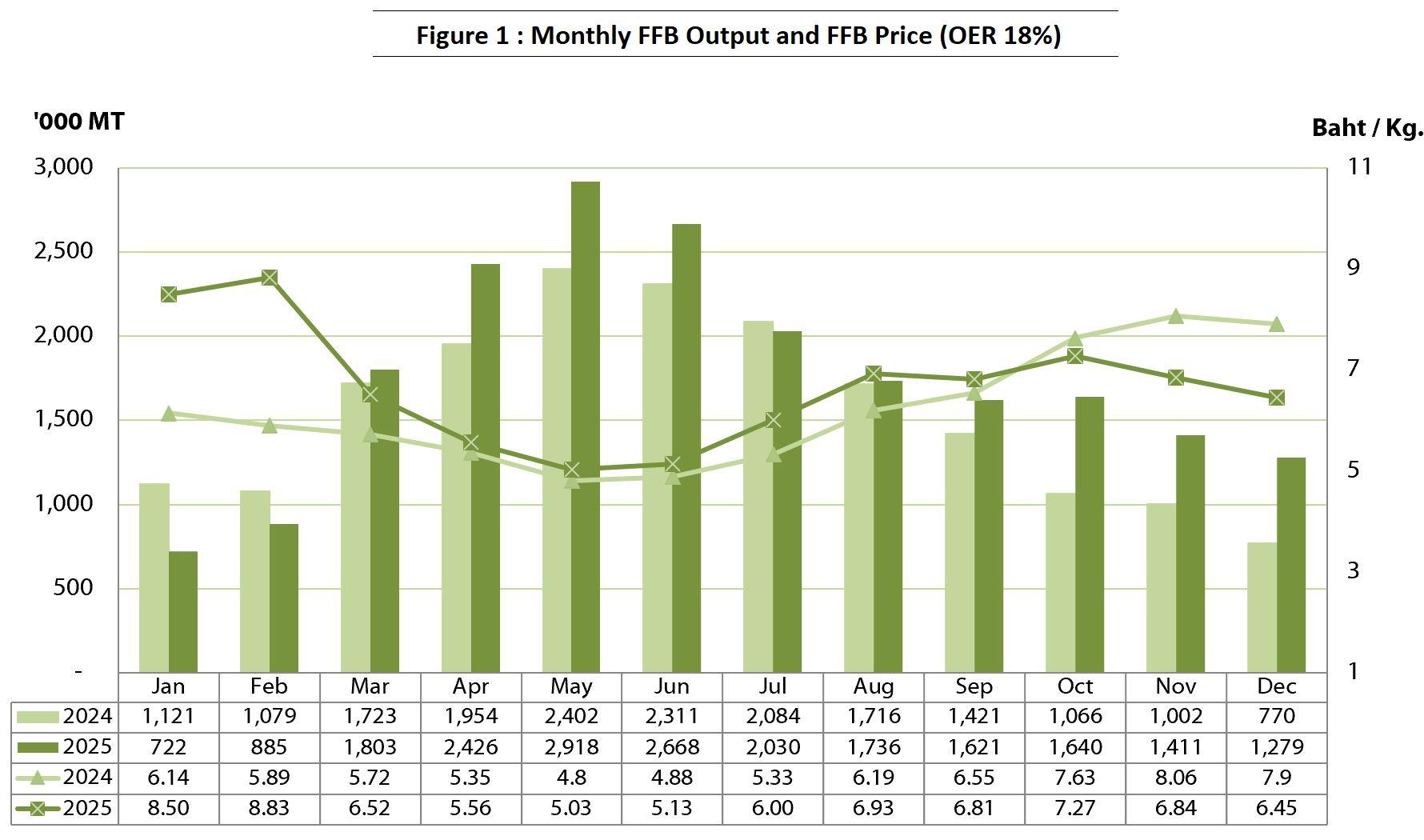
In 2025, monthly FFB output ranged from its lowest at around 0.72 million MT in January and to its peak of nearly 3 million MT in May, the highest record. The annual average FFB price in 2025 was at 6.66 Baht/Kg (2024 : 6.20 Baht/Kg) (2023 : 5.63 Baht/Kg), with the highest monthly average at 8.83 Baht/Kg in February and lowest at 5.03 Baht/Kg in May (Figure 1).
 Source : Department of Internal Trade
(b) Crushing Mills
Palm oil extracted from a crushing mill consists of CPO and CPKO. CPKO is extracted only from large-scale crushing mills that separate Palm Kernel from FFB. For small-scale crushing mills, palm oil is extracted from FFB without separating Palm Kernel, resulting in a mixed CPO.
Residual materials from the crushing process include palm fiber, palm shell, and empty bunch. Crushing mills utilises palm fiber and palm shell as the fuel for boiler to generate electricity for internal usage. Palm shell can be used as fuel to replace petroleum oil. Crushing mills sometimes sell palm shell instead of using it as the fuel for boiler; hence adding value to the industry. In some crushing mills, boiler is modified to use not only palm fiber but also empty bunch as fuel. Renewable energy from such Biomass lessens petroleum usage. Wastewater from the crushing process of CPO can also be used to produce biogas, which helps in treating wastewater and produces alternative energy. This can lower CPO production cost as well as conform to the government’s energy conservation policy.
The number of CPO crushing mills has increased from 91 mills in 2013 to about 120 mills at present (of which only 104 mills are still in operation), giving rise to a current total milling capacity of about 35 million MT of FFB per year. This is significantly higher than the FFB output recorded in 2025 at about 21 million MT; capacity utilisation rate of crushing mills was about 60% on annual average. Because of the significant imbalance between demand and supply, there is an intense competition to buy FFB from farmers to minimise the production cost, perhaps ignoring the quality, leading to price volatility and compromising FFB quality, ultimately hindering the development of the palm oil industry in Thailand.
Supply
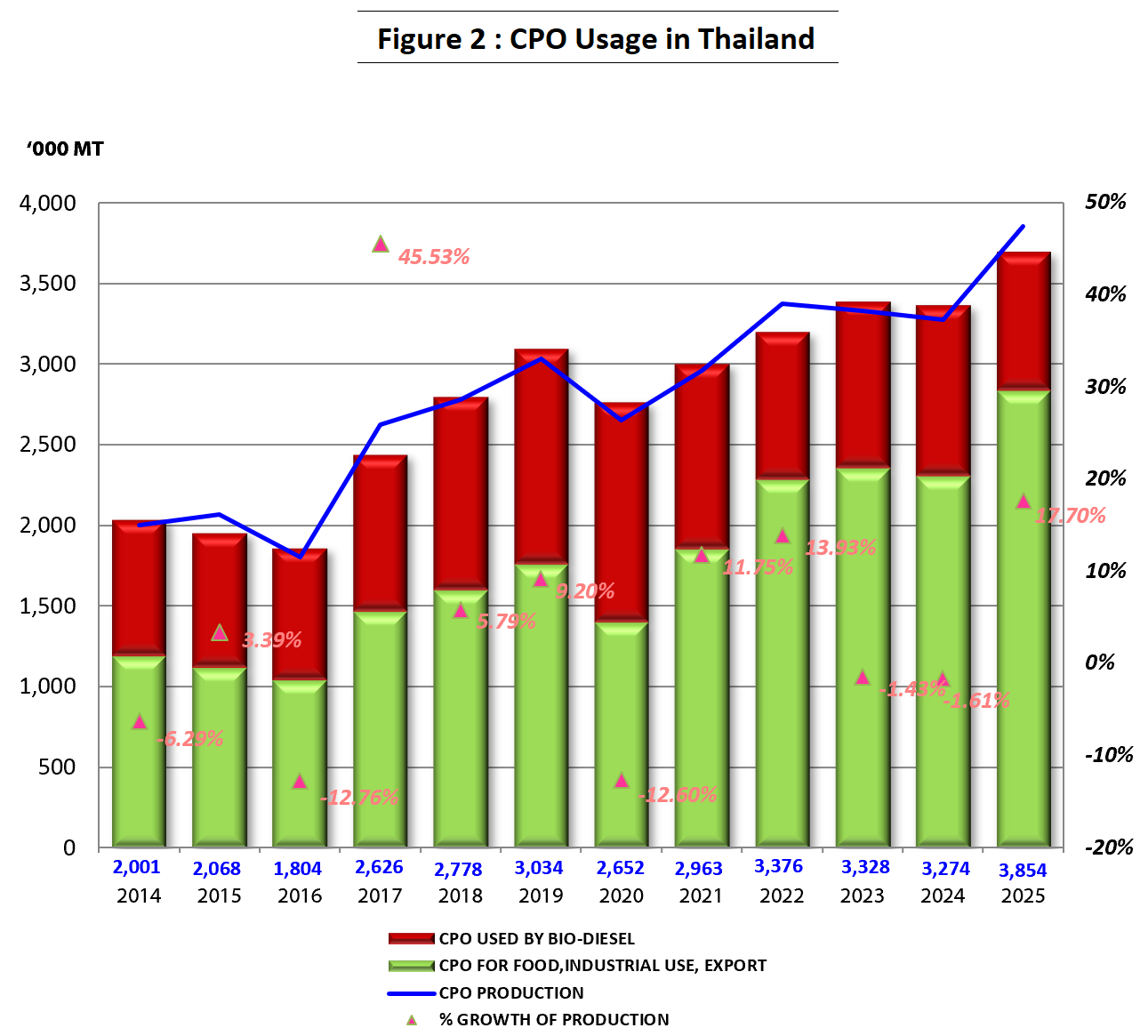
Each year was characterised by volatility in crude palm oil supply, depending on FFB output each season. Total CPO production in the Kingdom in 2025 was 3,854,089 MT, a substantial increase from the previous two years (2024 : 3,274,374 MT) (2023 : 3,327,808 MT). The monthly volume was lowest in January at 126,539 MT and highest in May at 520,235 MT. For the second quarter of the year, both FFB and CPO output were at the highest with CPO stock nationwide at the end of August surging to 506,718 MT, exceeding the optimum level as high as 200,000 MT.
Demand
During 2020 - 2025, the demand for CPO for consumption in Thailand annually increased by 7%, whereas CPO for energy sector decreasing by 8% per year. In 2025, demand for CPO for consumption and other industries was 1.61 million MT, increasing from 2024, while demand for CPO for renewable energy amounted to 0.86 million MT, a significant decrease from 2024 (Figure 2).
Source : Department of Internal Trade
CPO demand in the Kingdom was shared between :-
(MT) | 2024 | 2025 | % Change |
Consumption and others | 1,437,063 | 1,611,375 | 12.13 |
Biodiesel | 1,054,011 | 860,030 | -18.40 |
(c) Refinery and Downstream Industries
The downstream processing capacity of palm oil in Thailand is mainly as follows:-
1. Refineries : There are a total of 22 refineries in Thailand giving a current refining capacity of about 2.5 million MT of input per annum. The capacity utilisation is estimated at 70%. When compared with a large number of crushing mills, there are fewer players because of entry barriers for newcomers in the form of huge capital investment cost, know-how, and technology. Nevertheless, competition among refineries started to intensify in the past 4 - 5 years as the players apply price strategy in an attempt to gain market share.
2. Biodiesel Plants : Thailand maintains a total of 14 fatty acid methyl easters plants with an aggregate production capacity estimated at approximately 11.66 million liters per day. The cost structure associated with biodiesel production is predominantly composed of crude palm oil, accounting for roughly 70 percent of total production costs, followed by chemical inputs at 20 percent and operational expenditures at 10 percent.
The national demand for high-speed diesel has exhibited a consistent upward trajectory, supported by structural expansion in diesel-powered transportation, the robust growth of the e-commerce sector—which has contributed to an increased reliance on commercial delivery vehicles, particularly pickup trucks—and deeper economic integration within the ASEAN region.
In 2024, Thailand’s average diesel consumption reached 68.8 million liters per day, including approximately 4.29 million liters per day of B100 biodiesel. Projections for 2025 indicate a rise in average diesel consumption to 69.8 million liters per day. Nevertheless, B100 biodiesel consumption is expected to decline to around 3.29 million liters per day, reflecting the government’s policy adjustment that reduced the mandatory blending ratio from B7 to B5.
In the longer term, the implementation of the national electric vehicle (EV) promotion strategy—aimed at ensuring that zero-emission vehicle (ZEV) constitute 30 percent of total automotive production by 2030—may impose downward pressure on the demand for bio-based fuels. EV adoption in Thailand expanded substantially in 2025, reaching approximately 18 percent compared with the previous year. Additionally, the enforcement of the European Union Deforestation Regulation (EUDR) would encompass palm oil cultivated in high-carbon stock areas.
Concurrently, domestic consumption of crude palm oil—across both food and industrial applications—has not demonstrated sustained growth commensurate with increases in supply. This imbalance suggests that Thailand’s palm oil industry is likely to encounter a persistent structural oversupply in the foreseeable future. Consequently, the industry will continue to depend increasingly on crude palm oil exports as a mechanism for absorbing surplus production.
3. Export : In 2025, since having the gap between CPO price in Thailand and the world market in particular periods, especially during the second and third quarter, Thailand was able to export CPO and its products continually from 2021. In 2025, the total export volume of CPO was recorded highest at 1,227,545 MT, compared with 872,328 MT in 2024 and 905,685 in 2023.
FFB and CPO price
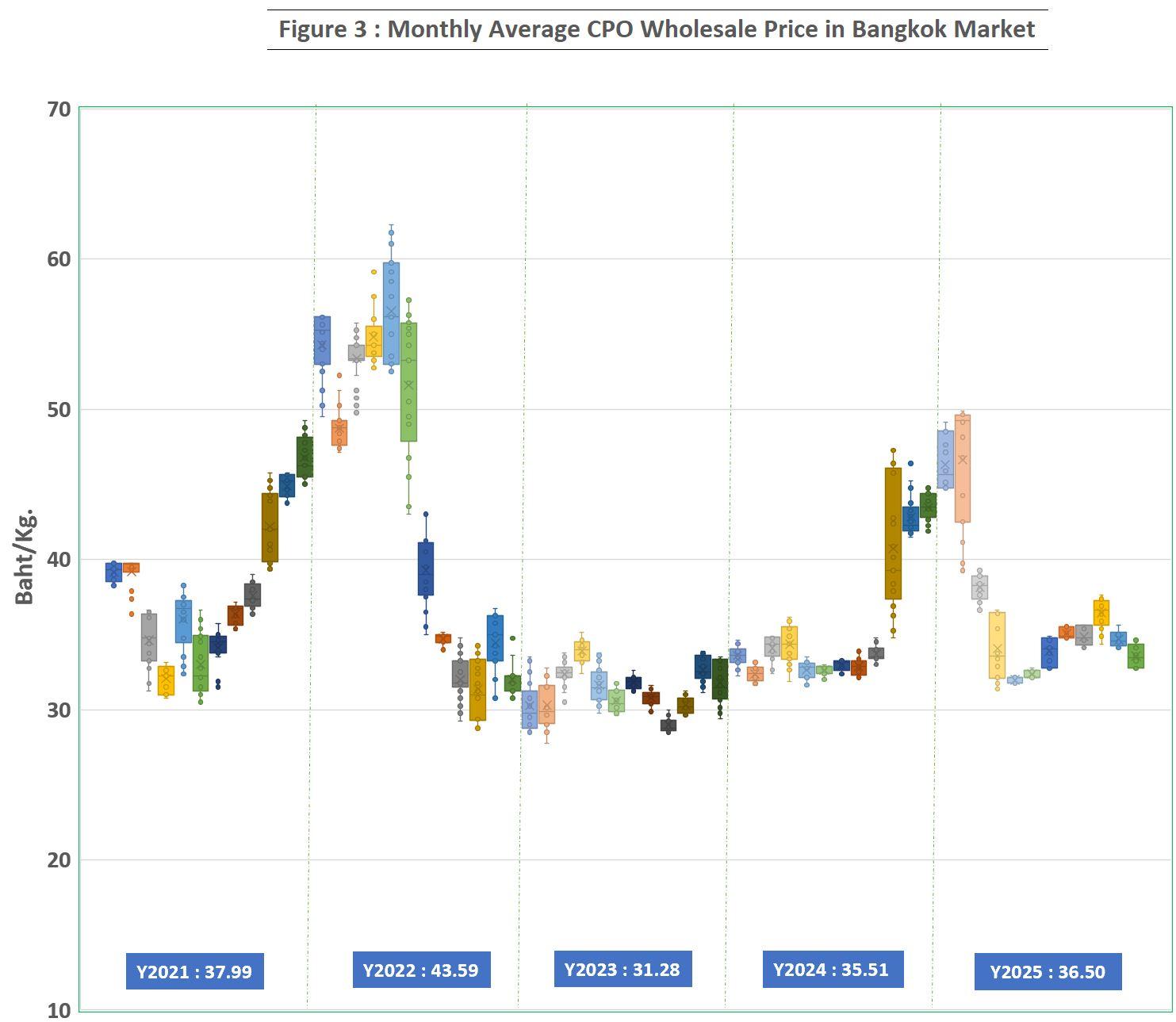
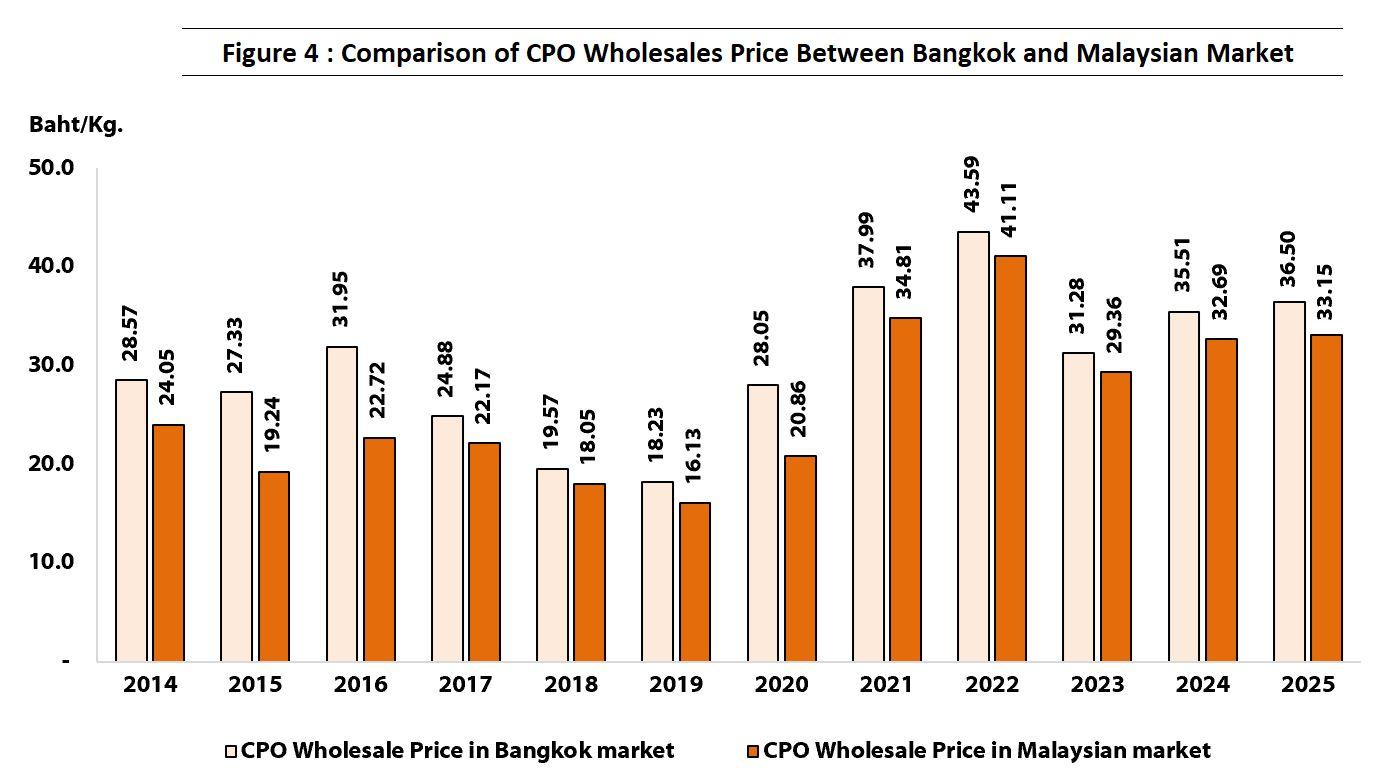
Local prices of oil palm and palm oil depend on the output, usage volume, and CPO stock in nationwide, including the situation of palm oil price in world market as well as prices of other vegetable oils that can be substituted. Monthly CPO price in the Kingdom in 2025 varied between 31.98 – 46.63 Baht/Kg (2024 : 32.38 – 43.44 Baht/Kg). The annual average CPO price was 36.50 Baht/Kg., 2.79% increase from 2024 (2024 : 35.51 Baht/Kg). CPO price in the Kingdom had reached its highest in February and lowest in May (Figure 3). The average price gap from the global market was at 3.35 Baht/Kg (2024 : 2.82 Baht/Kg).
Source : Department of Internal Trade
From Figure 4, it can be seen that in 2025, the average spread compared to the world market has widened when compared with 2024. The average domestic CPO price remained at a high level during the first three months of the year in consistence with global price movements. Combining with a period of low domestic production, CPO stock continually decreased until reaching a critical low level at 136,357 MT. in late February.
Source : Department of Internal Trade
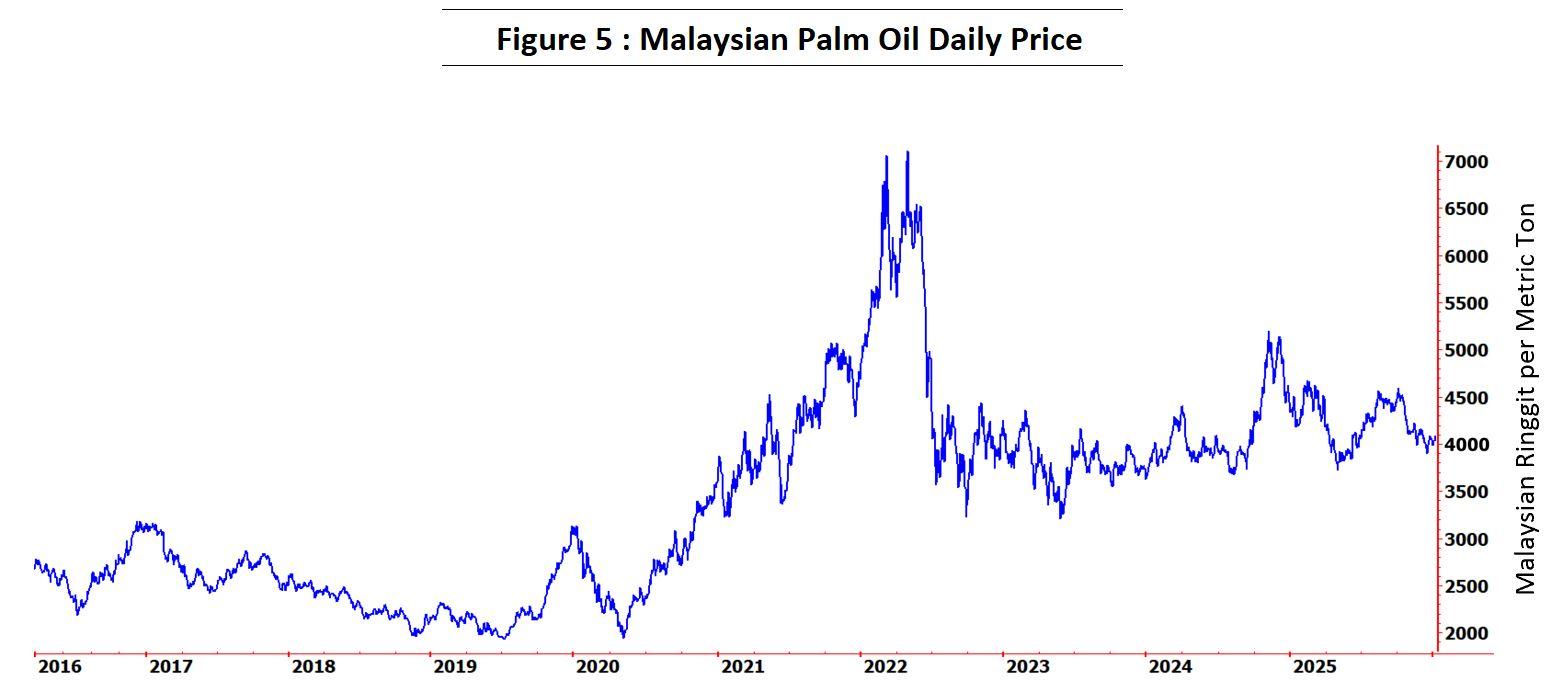
From Figure 5, it can be seen that in 2025, palm oil price in the world market was decreased continuously with the highest CPO price at 4,720 ringgit per MT. on 21 February 2025 then heading down to the lowest at 3,696 ringgit per MT. on 7 May 2025. The primary cause was from the trade war between China and the United States, which led to a decline in global soybean oil price. In addition, Indonesia announced a postponement of the implementation of its policy to increase the biodiesel blending mandate in diesel fuel to 50% (B50).
Industry Trend and Competition Outlook
In 2026, the overall palm oil industry is expected to expand aligning with the domestic and international demands, especially from the food and oleochemical industry that growing in line with the economic recovery. However, the Biodiesel industry is expected to remain unchanged. The demand for palm oil consumption within the Kingdom is estimated at approximately 1.6 - 1.7 million MT., the demand for palm oil for biodiesel production at approximately 0.8 - 1 million MT. as far as the Ministry of Energy maintains the blending ratio of palm oil in diesel at no less than 5% (B5), continuing from 2025 in order not to have the cost of diesel production been too high which would be a burden for fuel users.
The Office of Agricultural Economics forecasted the harvested area in 2026 at 6.58 million rai, compared with 6.44 million rai in 2025. The overall FFB output in 2026 is forecasted to be at a high level around 20 - 21 million MT., supported by above-average rainfall level and well-distributed precipitation from mid-2025 through early 2026.
For the pricewise, the domestic CPO price is expected to move aligning to the global price. In 2026, the price of palm oil in global market is expected to trend downward, reflecting an anticipated increase in production. Accordingly, the average CPO price for the year 2026 is forecast to range between 35 – 37 Baht/Kg. and the average price of FFB at 6 - 7 Baht/Kg. Nevertheless, there might be a significant demand-side driver in the second half of 2026, namely Indonesia’s plan to increase the biodiesel blending mandate in diesel fuel to 50% (B50). In addition, the Indonesian government has announced an increase in export levies to curb CPO export and mobilise fund to support B50 production. Furthermore, other key factors include:
The trade war between China and the United States is expected to affect demand for palm oil, as a result of changes in the global soybean oil supply chain. China is likely to reduce its import of soybeans from the United States and shift to Brazil, or partially replace the consumption of soybean oil by palm oil.
Geopolitical conflicts will heighten risks to energy supply and impact shipping routes, thereby affecting petroleum price then palm oil price as well as global production and logistics costs.
The Fuel Fund Act B.E. 2562 (2019) provides for compensation to fuels blended with biofuels. Pursuant to the Cabinet resolution dated 17 September 2024, the compensation period has been extended a further two years, until 24 September 2026.
Increasingly stringent sustainability and traceability requirements in palm oil production, including environmental regulations, deforestation control, verification of upstream raw material source and throughout the supply chain, and certification of sustainable palm oil production in accordance with standards such as the Roundtable on Sustainable Palm Oil (RSPO)
The promotion of electric vehicles (EVs) under the 30@30 policy, which targets the production of zero-emission vehicles (ZEVs) to account for at least 30% of total vehicle production by 2030 (B.E. 2573), represents another key mechanism for steering Thailand toward a low-carbon society. This development may have long-term implications for biodiesel consumption and palm oil demand.
In view of long-term developments, the context of palm oil will be forced to change from cheap and environmentally damaging vegetable oil to the production of palm oil certified to sustainability and traceability standards. In addition, increasing the value of palm oil for use as raw material for producing environmentally friendly bio-products and promoting the high valued oleochemical industry to replace the demand for CPO for biodiesel production tends to decrease in the future.
However, a direction of palm oil industry in terms of development and evolution to a high level is unclear. A systematic extension to various downstream industries requires high capital investment to generate economies of scale. Currently, excess supply of palm oil left over from domestic consumption has increased. However, the volatility of palm oil quantity and price remains problematic and threatens market equilibrium and further developments.
Number of Competitors and Company Size Compared to Competitors
Currently, the harvested oil palm plantation area in the Kingdom is about 6.4 - 6.5 million rai, most of which is in the southern region due to the favorable climate. Since 2016, there has been a continuous expansion of oil palm plantation areas, resulting in a significant increase in the total amount of FFB in the country, especially from 6 provinces namely Surat Thani, Krabi, Chumphon, Nakhon Si Thammarat, Trang and Phang Nga. The volume of FFB output in 2025 amounted to 21.14 million MT (2024 : 18.65 million MT) and is expected to increase further in 2026.
Palm oil factory can be divided into three types i.e. crushing mill, refinery, and biodiesel plant. Most of the crushing mills are located in the southern region, with 120 plants in total but only 104 plants are still in operation, with a total production capacity of 35 million MT - FFB per year.
For most refineries located in Bangkok and its vicinity, there are 22 plants with a total production capacity of 2.5 million MT of raw material per year, most of which are large plant and the capacity utilisation rate at about 70%. The Company's refinery has a production capacity of 256,200 MT of CPO per year, which is considered a large refinery. The crushing mill has a capacity of 45 MT - FFB per hour.
There have been 14 biodiesel plants, with capacity of around 11.66 million liters per day. However, at present, the Company has not operated the biodiesel plant.
At present, the Company holds an approximate 10% market share in the palm oil business, based on the purchased volume of CPO producing for food and industrial use.
Competitive Potential
The Company has been operating business in the palm oil industry for more than 50 years and constantly developing machinery and production technology, including research and development of products, thereby giving the Company a high competitive position and potential, which include improving the production systems of the Margarine and Shortening plant and the Refinery, as well as focusing on the secured sourcing of raw material by supporting the integration of smallholders, and the improvement and development to increase the efficiency of the CPO production process at the Trang Crushing Mill. In addition, the Company has been certified by the Good Hygiene Practices (GHPs), the Hazard Analysis Critical Control Point system (HACCP), food safety quality assurance system (FSSC22000) and ISO 9001, ISO 14001, ISO45001, TLS8001, ISO/IEC17025, HALAL Food quality assurance system, Kosher quality assurance system, organic agriculture system and the Roundtable on Sustainable Palm Oil (RSPO) through supply chain from plantation, crushing mill, until refinery. Furthermore, the Company has been certified for the Carbon Footprint for Organization (CFO) and the Carbon Footprint of Product (CFP). These standards reflect the Company’s commitment to efficient and sustainable business operations, thereby enhancing stakeholder confidence and supporting the Company’s sales growth. The Company also uses a SAP system that can provide fast and efficient information of inventory to respond quickly to customers and providing insights for effective management decisions.
The Company is a major shareholder of United Palm Oil Industry Public Company Limited, the owner of one largest palm oil plantations in the Kingdom, enables the Company to operate a fully integrated business and track the quantity of FFB output each season closely, this will affect the market price of FFB and CPO, which is the main raw material of the Company. Moreover, being a major shareholder of Universal Food Public Company Limited (UFC) has resulted in the Company having a wider variety of products while having similar distribution channels, allowing the Company to use its resources effectively and also reduce operating costs as well.
Domestic/Export Sales Ratio (Overall)
| Country | Ratio (%) |
|---|---|
| Thailand | 97.13 |
Procurement of Products & Services
Reporting Mode
3117
Procurement (Overall)
The Company’s major products are refined palm oil products and other derivative products. The Company operates its own production from CPO and CPKO by which the Company procures raw materials from the crushing mill in Trang, which is the Company's own plant, including the purchase of raw materials from United Palm Oil Industry Public Company Limited, a subsidiary. The rest is the purchase of raw materials from other crushing mills from outside.
For other types of vegetable oil products, including derivative products, the Company has both own production, import from abroad and buy from domestic manufacturers for further production and distribution.
Raw Material Acquisition (Overall)
CPO is an important raw material for the Company's products, accounting for approximately 85% of the production cost. The main raw material for CPO production is FFB. FFB consists of two major parts that provide oil, namely, the pericarp for the CPO and palm kernel to provide CPKO. The oil extraction rate will be more or less depending on the palm varieties, rainfall, maintenance and crushing process. On average, the pericarp contains 17-20% of oil, while the palm kernel at 40-45%.
FFB used in the production of CPO is obtained from the palm plantations of small - large farmers and private entity who collect FFB and sell out further. The Company purchases FFB to produce CPO at Trang Crushing Mill. Then the CPO will be transported as raw material to Bangpoo Refinery at Bangpoo Industrial Estate to be produced to refined palm oil.
Part of CPO used in the production of the Company's products is obtained from the Company's own crushing mill in Trang, and the rest is purchased from other crushing mills all over the Kingdom. However, the Company has a policy of not relying on any supplier, in order to guarantee the sufficiency of raw materials used in production.
During the past 3 years, the Company has not purchased raw materials from any supplier whose value exceeds 30% of the total raw material purchase value.
Production Policy (Overall)
The Company's manufacturing policy takes into account various factors such as market demand, quantity, quality, and price of major raw material in each season, including inventory management. This is then used as a guideline for production planning in order to meet customer satisfaction, under appropriate selling prices and cost of good sold.
Distributors (Overall)
CPO is an important raw material for the Company's products. Part of CPO used in the production of the Company's products is obtained from the Company's own crushing mill in Trang, including the purchase of CPO from United Palm Oil Industry Public Company Limited, a subsidiary. The rest is the purchase from other crushing mills from outside.
The Company has good and long-term relationships with key raw material suppliers, so there is no problem in the adequacy of main raw material, except in certain seasons when the market may experience shortages of FFB output due to drought weather condition.
Number of Raw-Material Distributors (Overall)
10
Production Capacity (Overall)
| Item | Unit | Used | Capacity |
|---|---|---|---|
| Crushing Mill | Ton | 46 | 394,200 |
| Palm Oil Refinery | Ton | 85 | 255,500 |
Domestic/Overseas Purchase Proportion (Overall)
| Raw Material | Source Country | Value |
|---|---|---|
| Crude Palm Oil | Thailand | 4,000,000,000 |
Nature of Business — Overview
Introduction
Lam Soon (Thailand) Public Company Limited operates a crushing mill and a palm oil refinery with its refining capacity at 700 MT per day or 255,500 MT per year. Lam Soon Group sells and markets its product line which includes:
1. Crude Palm Oil and By-Products
2. Refined and processed palm products
3. Other Oil Products (Non-Palm)
4. Margarine and Shortening group
5. Canned fruits and vegetables group
6. Beverage group
7. Sauce & Seasoning group
8. Flour and Bakery ingredients group
9. Spices and Herbs group, Sauces and condiments / Spices
10. Pasta group
11. MISC Food Items e.g. Organic Rice (Jasmine Brown Rice / Riceberry / RD 43 Rice)
12. Household care products
Of the Company’s above product line, Processed Palm Oil has contributed 44.4% (2024 : 43.4%) of its total sales, while the Company currently has approximately 10% market share in the palm oil business (measured by CPO volume purchased for consumption).
Projects Under Construction
Has Projects Under Construction (Y/N)
No
Debentures & Bills of Exchange
Has Debentures (Y/N)
No
Convertible Securities
Has Convertible Securities (Y/N)
No